
Full body hiit is one of the simplest ways to train when time is tight but you still want that “I actually did something” feeling after a session.
That said, “fast results” can mean different things, fat loss, conditioning, muscle tone, or just not getting winded on stairs, and HIIT only works well when intensity and recovery match your current fitness level.
This guide gives you a repeatable full-body session, options for beginners and more advanced folks, plus a practical weekly plan so you can progress without burning out.
What “fast results” from HIIT usually looks like (and what it does not)
Most people notice changes in conditioning first, you recover quicker between efforts, your heart rate settles faster, and workouts feel less intimidating. Visual changes can happen too, but they depend heavily on food, sleep, stress, and how often you train.
According to the American College of Sports Medicine (ACSM)... HIIT can improve cardiorespiratory fitness, but it also places high demand on the body, which is why quality programming matters more than simply “going harder.”
- Quick wins you might feel in 2–4 weeks: better stamina, improved work capacity, more confidence with bodyweight moves.
- Changes that vary a lot: scale weight, visible muscle definition, major strength gains.
- What HIIT is not: a replacement for all strength training forever, or a license to ignore recovery.
Why full-body HIIT works (and when it backfires)
Full-body sessions are efficient because you rotate through legs, push, pull, and core patterns, so no single area gets hammered nonstop. That lets you keep intensity up while spreading fatigue across muscle groups.
Where it backfires is predictable: people stack too many high-impact moves, shorten rest to “prove toughness,” and repeat the same session every day. The result is sore joints, declining performance, and motivation that quietly evaporates.
Signs your approach is working
- You can keep form solid for most intervals, even when breathing gets heavy.
- Week to week, you complete slightly more work: one extra round, cleaner reps, or heavier resistance.
- You feel tired after training, not wrecked for two days.
Signs you should pull back
- Nagging knee/ankle pain, sharp back discomfort, headaches after hard sessions.
- Sleep gets worse and your resting heart rate trends up.
- You dread workouts because every session feels like a test.
Pre-workout self-check (30 seconds that saves you weeks)
Before you jump into a full body hiit session, do a quick check-in. It sounds basic, but it prevents the common “I went too hard on a bad day” spiral.
- Sleep: less than 6 hours or poor quality? Choose low-impact options.
- Joint status: any sharp pain today? Swap jumps for step-backs or marching.
- Breathing: can you nasal-breathe comfortably while standing? If not, extend warm-up.
- Last hard session: within 24 hours? Consider strength or mobility instead.
The full body HIIT workout (no equipment) + smart options
This is a practical, repeatable template. Aim for strong effort, but keep reps clean. If you have medical concerns or a history of injury, it may be worth consulting a qualified fitness professional.
Warm-up (5 minutes)
- 30 sec easy marching or light jog in place
- 30 sec hip hinges (hands on hips, practice the pattern)
- 30 sec arm circles + shoulder rolls
- 30 sec bodyweight squats (slow, controlled)
- 30 sec alternating reverse lunges (shallow range if needed)
- 60 sec plank walkouts or incline walkouts to a bench
- 60 sec easy jumping jacks or step-jacks
Main workout (18 minutes)
Format: 40 seconds work, 20 seconds rest. Complete 3 rounds of the 6 moves below. Rest 60 seconds between rounds.
| Move | Targets | Beginner option | Harder option |
|---|---|---|---|
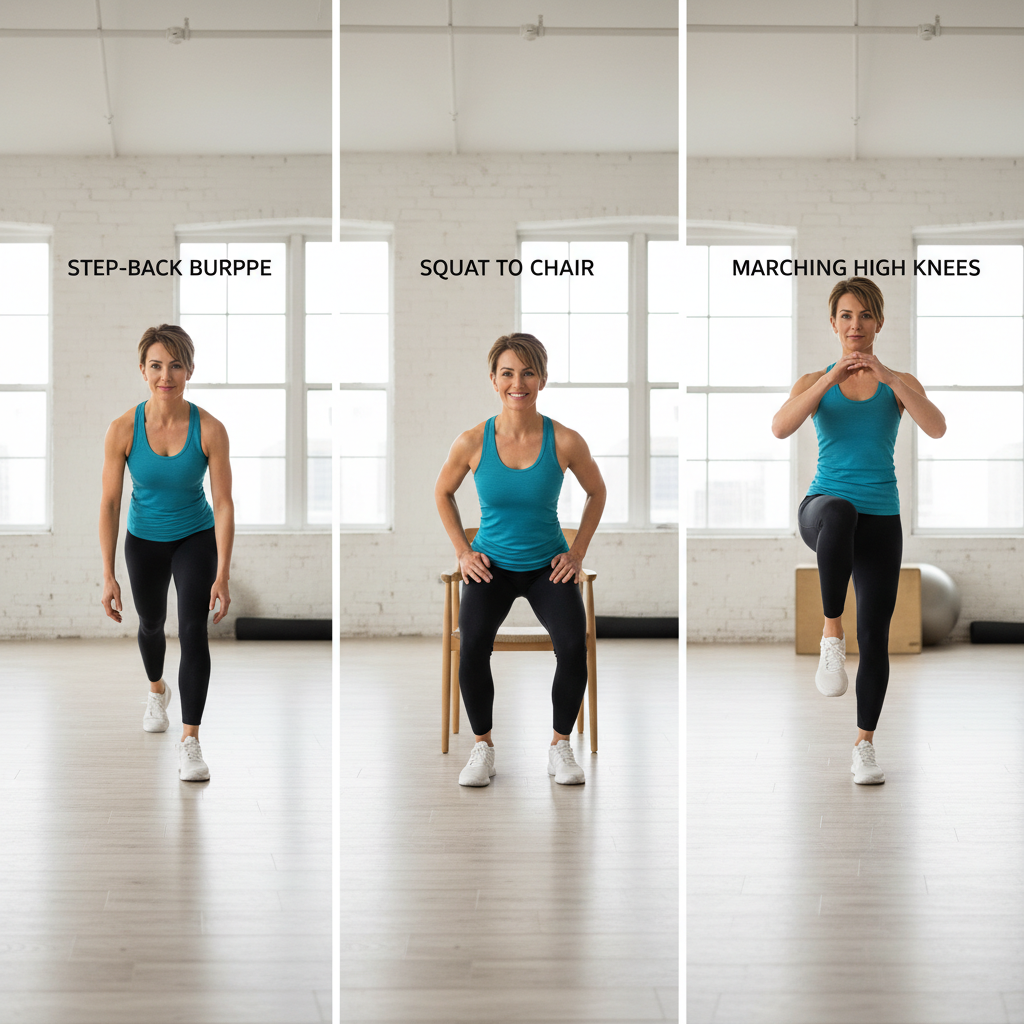
| Squat to reach | Legs, core | Squat to chair | Jump squat (only if joints tolerate) |
| Push-up | Chest, triceps, core | Hands elevated on bench | Tempo push-up (3 sec down) |
| Reverse lunge + knee drive | Glutes, balance | Static split squat | Switch lunge (low bounce) |
| Plank shoulder taps | Core, shoulders | Knees down | Feet wider, faster taps with control |
| Hip hinge “speed skater” step | Glutes, cardio | Side steps, slow | Skater hops (if safe) |
| Mountain climbers | Cardio, core | Hands elevated, slower pace | Cross-body climbers |
Cool-down (4–6 minutes)
- Slow breathing: 5 deep breaths, longer exhale than inhale
- Hip flexor stretch, 30–45 sec each side
- Calf stretch, 30 sec each side
- Chest opener against a wall, 30 sec each side
How to progress for faster results (without frying yourself)
The best progress usually looks boring on paper: small changes, kept consistently. When people stall, it’s often because every session is “all-out” and there’s no runway to improve.
- Week 1–2: keep the same intervals, focus on clean reps and steady breathing.
- Week 3: add one round, or add 10 seconds of work to each interval.
- Week 4: keep volume, increase difficulty on 1–2 moves (not all six).
If you use weights, the simplest upgrade is adding light dumbbells for squats and lunges while keeping the same timer.
A realistic weekly plan (so HIIT helps instead of hijacks recovery)
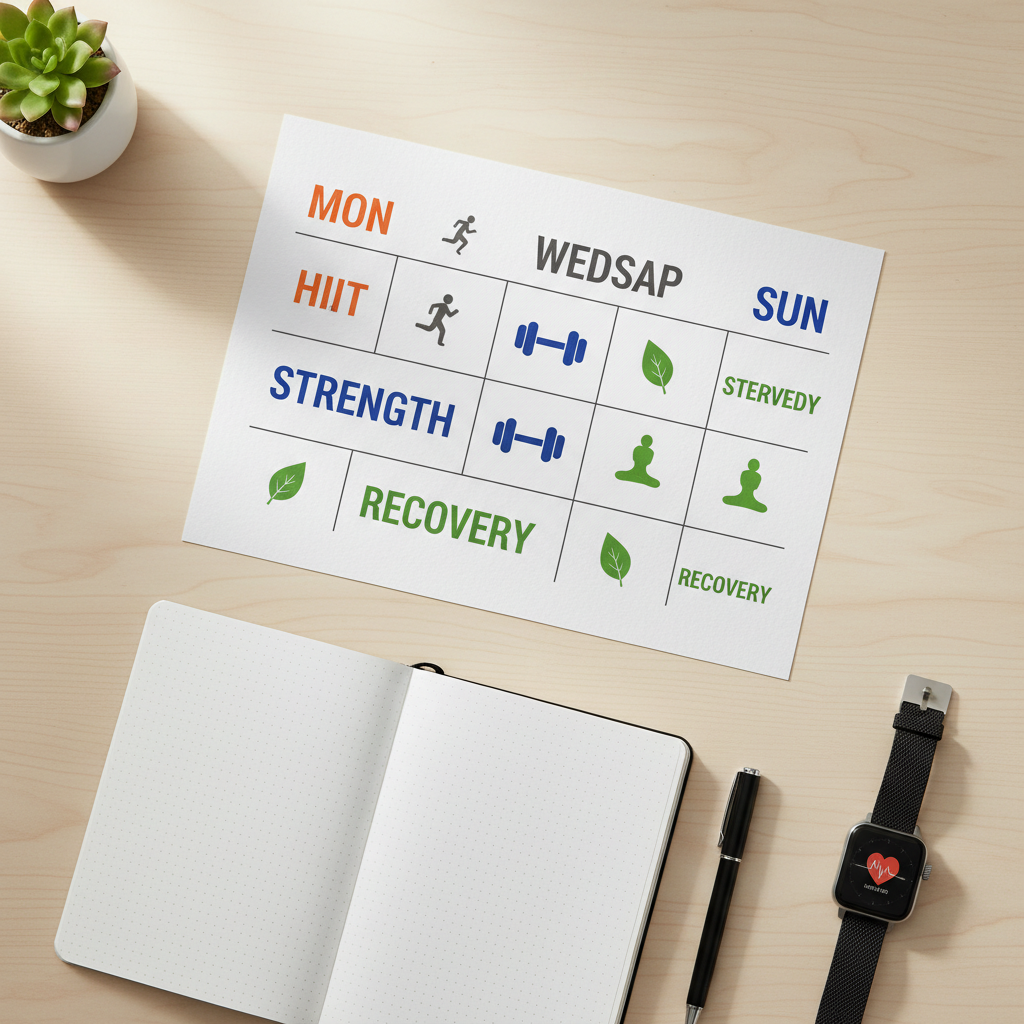
For most adults, 2–4 HIIT sessions per week is a workable range, depending on training age, stress, and sleep. More is not automatically better, especially with a full body hiit format that taxes a lot at once.
- Option A (2 days/week): HIIT Tue + Fri, strength or walking on other days.
- Option B (3 days/week): HIIT Mon + Wed + Sat, light cardio or mobility between.
- Option C (4 days/week): only if intensity stays controlled and at least 1 day is low-impact.
According to the Centers for Disease Control and Prevention (CDC)... adults should aim for regular aerobic activity plus muscle-strengthening work during the week, so pairing HIIT with basic strength patterns is usually a safer long-term mix than doing intervals every day.
Common mistakes that slow progress
- Chasing sweat instead of output: you want consistent effort, not just feeling destroyed.
- Picking only flashy moves: if you skip hinges, squats, pushes, and core stability, you miss the “full-body” part.
- Resting too little: short rest looks hardcore, but form collapses and intensity becomes fake.
- Going high-impact by default: jumping is optional, joints are not.
- Ignoring food and sleep: “fast results” usually disappear when recovery stays weak.
Key takeaways + when to get professional help
Key takeaways: a full body hiit plan works best when you use repeatable movement patterns, track small progress, and keep at least one foot in recovery, sleep, steps, hydration.
Consider getting guidance from a qualified trainer, physical therapist, or clinician if you have chest pain, dizziness, a recent injury, are pregnant/postpartum, or you keep getting pain that changes how you move. In many cases, a few smart swaps make HIIT doable again.
If you want an actionable next step, run this workout twice this week, write down which move broke your form first, then adjust that one variable next session instead of changing everything.
FAQ
- How long should a full body hiit workout be?
Many people do well with 15–25 minutes of intervals plus a warm-up and cool-down. If your form falls apart at minute 8, the “right” length is shorter for now. - Is full-body HIIT good for fat loss?
It can help by increasing weekly activity and conditioning, but fat loss still depends on overall energy balance and consistency. HIIT is a tool, not a loophole. - Can I do HIIT every day for faster results?
Some can tolerate it for short periods, but many end up plateauing or getting achy. Alternating HIIT with strength, walking, or mobility tends to work better long term. - What if I hate burpees and jumping?
You can keep intensity with step-back burpees, incline push-ups, fast marching, or loaded carries if you have weights. “Hard” is about effort and control, not impact. - Should I eat before a HIIT session?
It depends on timing and tolerance. A small carb-focused snack 60–90 minutes prior helps many people, but if you feel nauseated, training lighter or adjusting timing may be smarter. - How do I know I’m pushing hard enough?
A common target is hard breathing where you can speak only a short phrase during work intervals, then recover enough to keep form for the next round. - What equipment actually helps most?
A timer and a mat go a long way. If you add one thing, adjustable dumbbells or a kettlebell usually gives the most progression options.
If you’re trying to make full body hiit a habit and you’d rather not guess your weekly structure, it can help to use a simple plan that tells you what to do on HIIT days and what to do on recovery days, so your effort goes into training, not constant decision-making.