
Gym workout routine is the phrase people search when they want a plan that feels clear on Monday, not confusing by Wednesday, and actually doable with work, sleep, and a normal life.
If you’ve ever bounced between random machines, copied a workout from social media, or trained hard for two weeks then disappeared for two months, you’re not alone. Most “weekly plans” fail because they ignore recovery, time limits, and what you’re trying to improve.

This guide lays out a realistic week structure, shows how to choose exercises without overthinking, and includes a simple progression approach so your workouts keep moving forward. You’ll also get a table you can follow as-is, plus swaps if your gym is crowded.
Quick heads-up: training advice is always context-dependent. If you have pain, medical conditions, or are returning after an injury, it’s worth checking with a qualified coach or healthcare professional.
What makes a weekly plan work (and why many don’t)
A weekly plan works when it matches three things: your schedule, your recovery capacity, and your goal. Miss any one of those and the plan looks great on paper but falls apart in practice.
- Too much intensity, too little recovery: People stack heavy days back-to-back, then wonder why joints feel cranky and motivation drops.
- No progression method: If weights and reps don’t trend upward over time, your body has less reason to adapt.
- Exercise roulette: Novelty can be fun, but constantly changing movements makes it harder to build skill and track improvement.
- Time-blind programming: A 90-minute plan sounds fine until you’re squeezing it into a 45-minute lunch break.
According to the Centers for Disease Control and Prevention (CDC), adults benefit from muscle-strengthening activities on 2 or more days per week alongside aerobic activity. That baseline already hints at a key point: consistency beats “perfect” workouts you can’t repeat.
Pick your goal first: strength, muscle, fat loss, or “general fitness”
“General fitness” is a valid goal, but it still helps to decide what you want most right now. Your gym workout routine changes depending on your priority.
- Strength focus: fewer exercises, more rest, lower reps, heavier loads, more practice with the big lifts.
- Muscle (hypertrophy) focus: moderate reps, slightly higher volume, good technique, consistent weekly sets per muscle group.
- Fat loss focus: strength training stays central, but steps/cardio and food habits often drive the outcome.
- General fitness: a balanced split, moderate volume, a little conditioning, fewer “max effort” days.
If you’re unsure, aim for general fitness with a slight muscle/strength bias. It tends to be the most sustainable and still looks good in the mirror.
A simple weekly gym workout routine (5 days) with built-in flexibility
This is a practical template for many US gym-goers: it hits each major muscle group 2x weekly (directly or indirectly), includes conditioning without wrecking recovery, and leaves room for life.
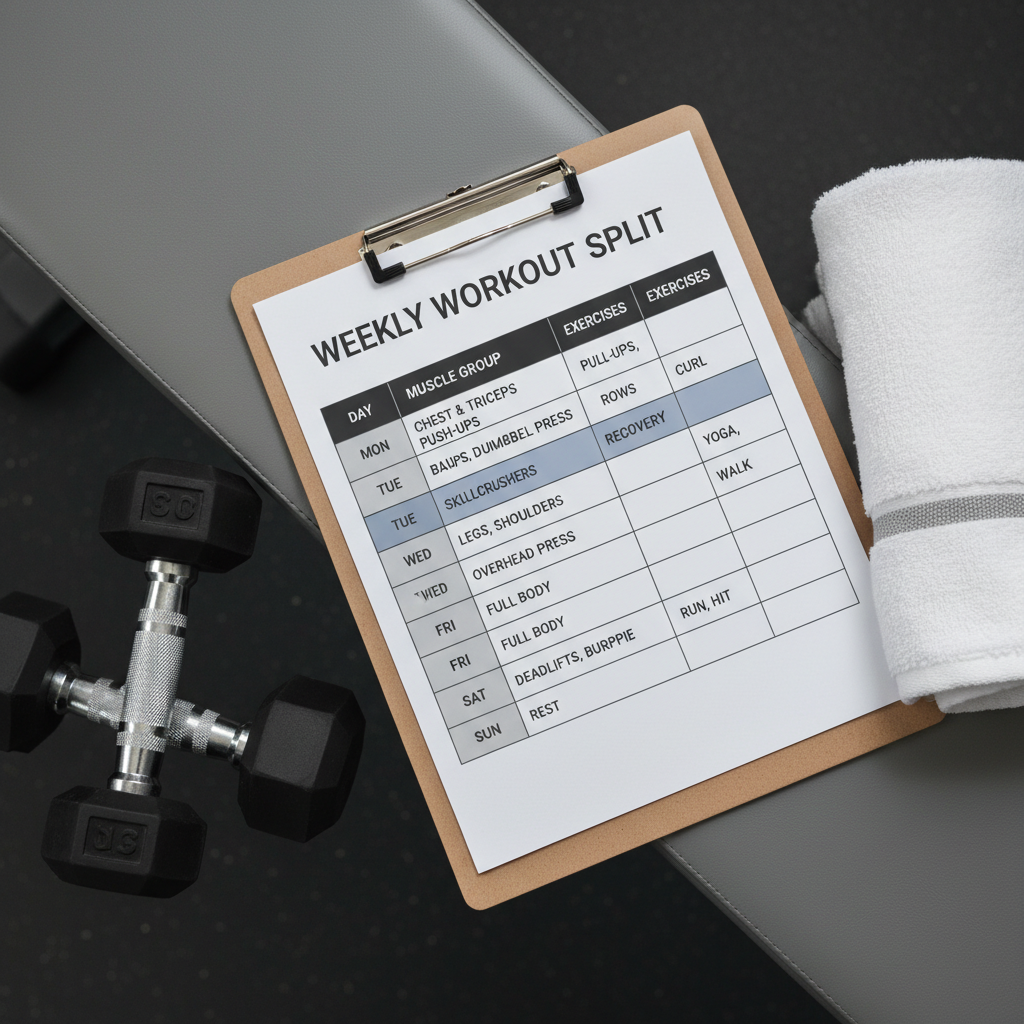
Weekly schedule table
| Day | Focus | Session length | Intensity feel |
|---|---|---|---|
| Mon | Lower Body (Strength) | 45–70 min | Challenging |
| Tue | Upper Body (Strength) | 45–70 min | Challenging |
| Wed | Active recovery + core | 25–45 min | Easy |
| Thu | Lower Body (Muscle) | 45–70 min | Moderate |
| Fri | Upper Body (Muscle) + optional conditioning | 45–75 min | Moderate |
| Sat | Optional: cardio / sport / long walk | 20–60 min | Easy–Moderate |
| Sun | Rest | — | Recover |
Day-by-day workouts (exercise menu)
Rule of thumb: leave 1–3 reps in reserve on most sets. You should work hard, but not grind every set to a shaky near-failure rep unless you know you recover well.
Monday: Lower (Strength)
Pick 4–6 moves, rest 2–3 minutes on the main lift.
- Back squat or safety bar squat: 3–5 sets of 3–6 reps
- Romanian deadlift: 3 sets of 6–10 reps
- Leg press or split squat: 2–3 sets of 8–12 reps
- Calf raise: 2–4 sets of 8–15 reps
Tuesday: Upper (Strength)
- Bench press or dumbbell bench: 3–5 sets of 3–6 reps
- Row variation (chest-supported row, cable row): 3–4 sets of 6–10 reps
- Overhead press: 2–4 sets of 4–8 reps
- Lat pulldown or pull-ups: 2–4 sets of 6–10 reps
- Optional: curls or triceps pressdowns: 2 sets of 10–15 reps
Wednesday: Active recovery + core
This day keeps your week sustainable. The win is showing up without digging a recovery hole.
- Zone-2 cardio (incline walk, bike, row): 20–30 minutes
- Core circuit (2–3 rounds): dead bug 8–12/side, side plank 20–40 sec/side, Pallof press 10–12/side
Thursday: Lower (Muscle)
More reps, slightly shorter rests, controlled tempo.
- Deadlift variation (trap bar, conventional, or light technique work): 2–4 sets of 3–6 reps OR skip if recovery feels tight
- Front squat or goblet squat: 3 sets of 6–12 reps
- Hamstring curl: 3 sets of 10–15 reps
- Walking lunges or step-ups: 2–3 sets of 10–14/leg
- Calves: 2–4 sets of 10–20 reps
Friday: Upper (Muscle) + optional conditioning
- Incline dumbbell press: 3 sets of 8–12 reps
- Lat pulldown or assisted pull-ups: 3 sets of 8–12 reps
- Machine chest press or push-ups: 2 sets of 10–15 reps
- Cable row or one-arm dumbbell row: 2–3 sets of 10–15 reps
- Lateral raise: 2–4 sets of 12–20 reps
- Arms superset (optional): curls + triceps: 2–3 rounds of 10–15 reps
If you want conditioning, keep it short: 8–12 minutes on a bike/rower, moderate-hard effort, no all-out heroics.
Quick self-check: is this routine a good fit for you?
Use this list before committing. It saves you from forcing a plan that doesn’t match your week.
- You can train 4–5 days most weeks, even if two sessions are shorter.
- You’re okay repeating core lifts for at least 6–8 weeks to build skill.
- You recover reasonably well: sleep is decent, stress not off the charts, nutrition somewhat consistent.
- You want structure but still need exercise swaps when equipment is taken.
If you only have 3 days, this can still work, but you’ll want full-body days instead of a split. If you want that version, say so and I’ll adapt it.
How to progress week to week without overcomplicating it
The most common “stuck” point is not effort, it’s progression. A gym workout routine needs a simple rule that tells you what to do when a weight feels easier.
Use a rep range + small load jumps
- Pick a rep range, like 6–10.
- Stay with the same weight until you hit the top of the range for all sets with clean form.
- Increase load by the smallest jump available (often 5 lb total on barbells, 2.5–5 lb per dumbbell) and repeat.
Key point: if your technique breaks, it doesn’t count as “progress.” This matters more than people want to admit.
Plan a lighter week occasionally
If you’ve pushed hard for 5–8 weeks, a lighter week often helps. Reduce sets by about a third, keep movement quality high, and let joints calm down. Many lifters come back stronger.

Practical execution tips (so you actually finish the week)
These are the boring details that make the routine stick.
- Warm-up in 8–12 minutes: 3–5 minutes easy cardio, then 2–3 ramp-up sets on your first lift. Save long mobility sessions for separate time.
- Cap your exercise list: 1 main lift, 2–4 accessories, 0–2 small finishers. More isn’t always better, it’s often just longer.
- Have “crowded gym” swaps: if the squat rack is taken, use hack squat, leg press, goblet squat, or split squats.
- Rest times matter: heavy compounds usually need 2–3 minutes, accessories often do fine at 60–90 seconds.
- Protein and sleep: not glamorous, but they heavily influence recovery. According to the American College of Sports Medicine (ACSM), resistance training is part of a balanced fitness program, and recovery behaviors help you benefit from it.
Common mistakes to avoid (especially for beginners)
A few pitfalls show up over and over, even in people who train regularly.
- Turning every set into a max test: it feels productive, but it usually makes the rest of the week worse.
- Copying an advanced split: body-part “bro splits” can work, but many people do better hitting muscles more than once weekly.
- Ignoring nagging pain: soreness is normal, sharp pain isn’t. Don’t push through joint pain to “prove” consistency.
- Major changes every week: keep exercises stable, adjust one variable at a time.
When to get extra help (coach, PT, or medical check)
Most training issues are solvable with better programming and patience, but some situations deserve a second set of eyes.
- Pain that changes your movement, lasts more than a couple weeks, or worsens session to session
- Repeated stalls despite adequate sleep, food, and a sensible progression approach
- History of injury or surgery and you’re unsure which movements to prioritize
- Symptoms like dizziness, chest discomfort, or unusual shortness of breath during training, in those cases stop and consider medical advice
According to the National Strength and Conditioning Association (NSCA), proper technique and appropriate progression help reduce injury risk in resistance training. A qualified coach can often spot small form issues that a mirror won’t.
Conclusion: a weekly routine you can repeat is the one that works
The most effective gym workout routine is usually the one you can run for months, not the one that looks intense online. Start with the weekly structure above, keep exercise choices steady, and use a simple rep-range progression so you’re not guessing each session.
Action steps: pick your training days for the next two weeks, write down your starting weights, and commit to completing the week even if a couple sessions are “minimum effective dose.” That’s how consistency becomes real.
FAQ
Is a 5-day gym workout routine too much for beginners?
It can be, depending on recovery and schedule. Many beginners do great on 3–4 days, but a 5-day plan works if the mid-week day stays easy and you avoid training to failure all the time.
How long should I follow the same gym workout routine?
Usually 6–12 weeks is a reasonable window. If lifts trend up and joints feel okay, keep going. If progress stalls and fatigue climbs, adjust volume, swap a couple exercises, or take a lighter week.
What if my gym is crowded and I can’t get a rack or bench?
Have swaps ready: dumbbell presses for bench, leg press or split squats for squats, cable rows for barbell rows. The goal is training the movement pattern, not defending one specific piece of equipment.
Should I do cardio on the same day as lifting?
Many people can, especially if cardio stays moderate and short. If leg recovery becomes an issue, separate hard cardio from lower-body lifting days or keep cardio as incline walking.
How do I know if I’m lifting heavy enough?
A practical test is effort: most working sets should end with about 1–3 reps left in the tank while form stays clean. If you finish every set feeling like you could do 8 more reps, load is likely too light.
Can I build muscle with machines only?
Often yes, especially for hypertrophy goals. Free weights add skill and stability demands, but machines can provide solid stimulus and are easier to standardize when learning.
What should I do if I feel pain during an exercise?
Stop the movement, don’t “test it” through sharp pain. Try a regression or swap, and if pain persists or affects daily life, consider guidance from a qualified professional.
If you’re trying to turn this into a plug-and-play weekly plan, a simple move is to share your available days, session length, and equipment access, then tailor the gym workout routine so it fits your real week instead of an ideal one.